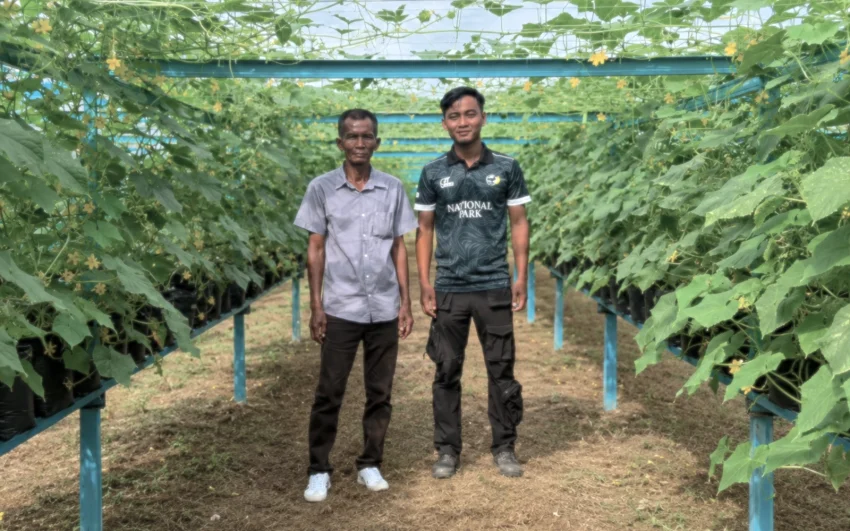

JERANTUT: Before reaching the wholesale market in Selayang, the cucumbers grown by Aiman Uyob and his father must first travel by boat.
Freshly harvested in Kampung Gusai, a remote settlement along Sungai Tembeling in Pahang, the produce is carried for up to an hour to the Kampung Bantal jetty.
From there, it is loaded onto a lorry for the journey of more than 100km to Jerantut, before arrangements are made to send it onwards to Selayang in Selangor.
It is a long route for a highly perishable crop, but the father-and-son duo have learnt to work around the realities of farming deep in Pahang’s interior.
In February, Aiman, 27, and Uyob Ahmad, 59, harvested about 14,000kg of “timun tua” from their first crop, bringing in roughly RM40,000. Their unlikely teacher? A smartphone.
Because of internet connection in the village, Aiman had to learn fertigation farming through video calls with a friend who operated a farm in Pulau Mansok, supplemented by whatever useful information he could find online.
“I learnt everything, from applying fertiliser to controlling pests,” he told Bernama. “At first, there was so much I didn’t know! But I kept learning step by step and, thankfully, the results have been very encouraging.”
Fertigation delivers fertiliser to crops through irrigation water, allowing farmers to manage nutrition and watering through a single system. For the pair, it offered a practical way to grow produce on limited land while securing a faster harvest.
Returning home to farm
Aiman had left Kampung Gusai in his early 20s to work at a factory in Kuala Lumpur, but city life did not suit him.
“Life there was very different, and I couldn’t adapt,” he recalled. “So I returned to the village and helped my father manage our banana smallholding.”

Working alongside Uyob gave him a closer look at the realities of agriculture, including its income potential and its frustrations. Bananas took time to mature, and even when the trees began bearing fruit, the harvest was far from guaranteed.
“Whenever the bananas started fruiting, monkeys and wild boars would appear,” Uyob said. “Many were damaged before we could harvest them, so we had to consider something more suitable.”
The pair began researching crops that could provide quicker returns and were less vulnerable to wildlife. Old cucumbers stood out because they can be harvested within 50 to 60 days and enjoy steady demand.
Rather than plant them conventionally, Aiman became interested in fertigation, which appeared easier to manage and required less space.
After several rounds of video calls with their friend, he travelled to Jerantut to buy seeds, fertiliser, polybags and other supplies. They then established their first plot of 2,000 polybags on a 0.76-ha site beside the family home.
“This system is much easier to manage, and the harvest comes much sooner,” Uyob noted.
A crop with ready buyers
Aiman and Uyob decided to focus entirely on old cucumbers. The crop is commonly used in dishes such as patin tempoyak and soups, giving it reliable appeal among traders and households.
Depending on market supply, the price can reach RM5 per kg. “Demand is consistently high, especially at the Selayang wholesale market, so that is where we send our produce,” Uyob said.
Growing the cucumbers is only one part of the job – getting them out of Kampung Gusai quickly enough is another. The river remains their preferred route because the alternative involves rough, unpaved roads accessible mainly by four-wheel-drive vehicles.
“River transport carries its own risks, but we are used to it,” Uyob said. “For us, it is still the easier way.”

The journey adds urgency to every harvest: cucumbers cannot sit for long in the heat, so picking, packing and transport must be carefully timed.
The pair’s persistence has attracted attention beyond the village. In May, the Sultan of Pahang, Al-Sultan Abdullah Ri’ayatuddin Al-Mustafa Billah Shah, visited the fertigation project after hearing about it from local residents.
The encouraging returns and royal visit have strengthened Uyob’s plans to expand. He hopes to increase the number of polybags and double production, while the pair have already entered their third planting cycle.
Their experience has also shown Aiman that returning home did not mean giving up on opportunity. Instead, it allowed him to combine his father’s knowledge of the land with information gathered through technology.
The internet connectivity may still falter, the river journey remains long, and the market is far away – but the cucumbers keep growing. For this father and son, that is reason enough to keep learning, planting and growing.