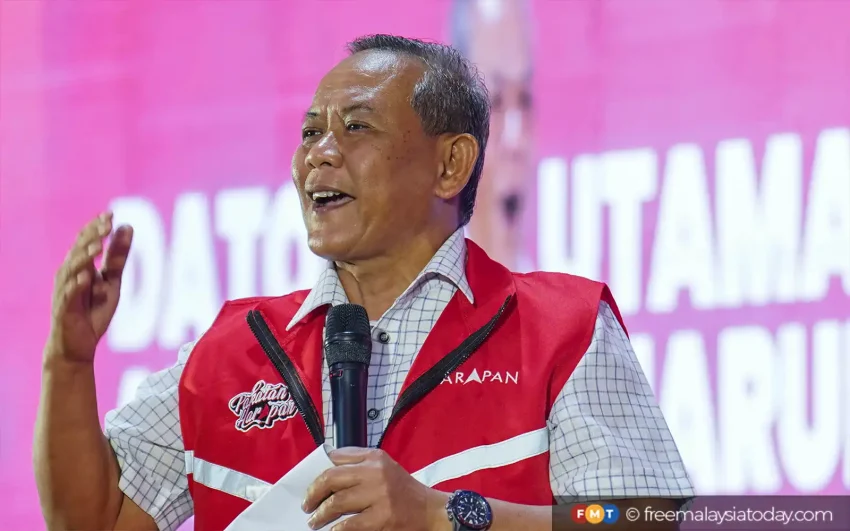

PETALING JAYA: Menteri besar Aminuddin Harun remains a highly popular figure in Negeri Sembilan, but this has not generated wider support for Pakatan Harapan in the state election, says a think tank.
Ilham Centre said its research showed that Aminuddin, fondly known as Tok Min, enjoys a high level of personal acceptance among voters, with his approval rating hovering around 75%.
This high rating was driven by his modest and approachable image, as well as his administrative record, which was seen as stable and free of major controversies.
“However, this personal popularity has not translated into broader electoral support for PH,” it said in a statement.
Ilham Centre cited Aminuddin’s decision to leave his previous seat, Sikamat, after four terms to contest the Umno stronghold of Linggi as a key factor that affected PH’s overall election campaign.
“Contesting a much more challenging constituency has forced Aminuddin to focus a significant portion of his time, energy, and resources to ensure his own victory.
“This situation indirectly limits his ability to play a role as a state leader who can mobilise the entire PH machinery,” it said.
It said Aminuddin’s focus on Linggi meant he was unable to strengthen PH’s campaign in key marginal seats that could benefit from a menteri besar’s presence and influence.
Aminuddin is in a three-cornered race for Linggi against Barisan Nasional’s Faizal Ramli and Bersatu’s Zamri Said.
Faizal won Linggi with a 1,461-vote majority over Perikatan Nasional in the 2023 state election, when PH and BN contested as allies.
Identity politics dominates state polls
Separately, Ilham Centre said identity politics has dominated this state election and is the dominant factor shaping voter behaviour, especially among the Malays.
It said campaigns were no longer focused on comparing administrative track records or government performance, but on identity-related issues such as religion, the position of the Malays and their political power.
“These narratives were consistently built throughout the campaign period, successfully changing the framework of voter consideration. Economic issues, state development, and administrative achievements are no longer the key determinants.
“On the contrary, voters are making their choices based on the perception of who is more capable of defending religious and racial interests,” it said.
The think tank said this was the backbone of the Barisan Nasional-Perikatan Nasional alliance’s campaign, which PH failed to counter on the campaign trail.
“Campaigning based on the state government’s achievements, governance and track record could not match the emotional strength that came with identity politics played up continuously during campaigning,” it said.
Demoralised after dismal Johor outing, PH on uneasy ground
Ilham Centre said PH’s machinery also appeared demoralised after suffering heavy losses in the July 11 Johor state election, where the coalition won only eight of 56 seats contested.
It said PH failed to capture the imagination of voters as it tried to promote the successes of Aminuddin’s administration, while its initial messaging appeared to be responding to criticism rather than actually delivering a focused narrative to voters.
The think tank said the second phase of PH’s campaign then pivoted to the controversial remarks by PN election director Sanusi Nor, hoping to shore up non-Malay support.
“The Kedah menteri besar’s remarks appear to have some effect on non-Malay voter sentiment, though its impact is not large enough to neutralise the wave of Malay-Muslim identity politics mobilised by BN-PN,” it said.