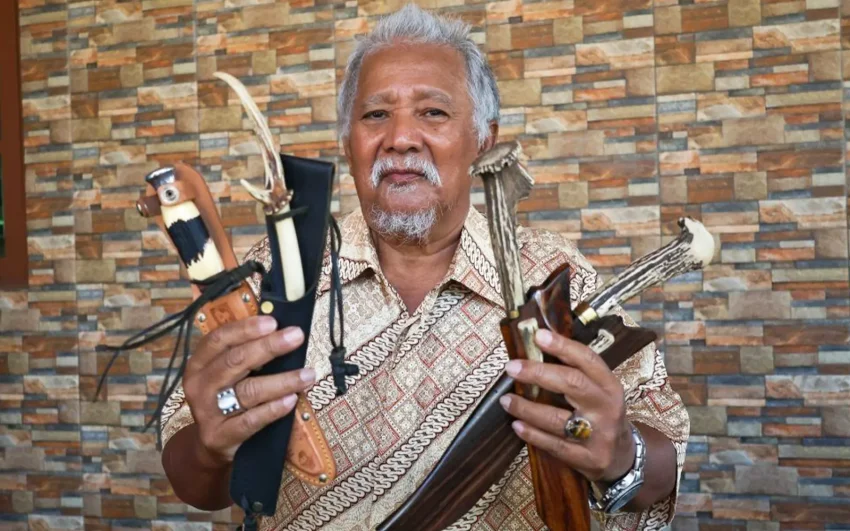

GUA MUSANG: Every three months, Ahmad Abdullah opens a special cabinet in his home and carefully inspects the blades inside.
He checks for signs of rust, applies a fresh layer of oil, and makes sure each weapon remains protected from the passage of time.
Among the more than 100 pieces in his collection, one golok receives particular attention.
The traditional single-edged cutting blade – similar to a short, heavy machete – has a finely carved hilt shaped like a bird clutching a nut in its beak.
“This is the golok I cherish most because its carving is exceptionally rare,” the 71-year-old retired civil servant said.
“It also reminds me of the person who introduced me to the art of blacksmithing.”
The blade was forged entirely by hand more than a decade ago by a renowned local blacksmith, who died several years later. With his passing, Ahmad believes something irreplaceable was lost.
“Whenever a blacksmith dies, part of that craft and knowledge disappears, too, unless it is passed on to the next generation,” he told Bernama.
For centuries, the golok has served communities across the Malay archipelago as both an agricultural tool and, historically, a weapon.
Its shape varies from one region to another, with differences in the blade, scabbard and hilt reflecting local traditions and the individual style of the craftsman.
In Ahmad’s treasured piece, the bird-shaped handle provides a firm grip while also carrying artistic and historical meaning.
He associates the motif with the Petalawali bird figure said to have appeared on vessels of the Kelantan sultanate that once carried the Bunga Emas tribute to Siam.
Whether viewed as a practical tool, an object of beauty or a reminder of an earlier age, the golok tells a story through every mark left by its maker.

Ahmad’s fascination with traditional blades began about 20 years ago, when he helped a blacksmith friend make hilts and scabbards.
From a single golok, his casual interest gradually grew into a deeper appreciation of the skill required to forge, shape and decorate each piece by hand.
Over the years, he has collected traditional and modern weapons from Malaysia and abroad, including machetes, knives, swords and keris.
His collection, estimated to be worth about RM20,000, includes pieces from Germany, Sweden, England, the US, Japan, China, Spain and Portugal.
Among his other prized possessions are a Sarawak knife with a deer-antler hilt, and a keris made from black kemuning wood with a golden kemuning handle.
Although collectors have expressed interest in buying several pieces, he refuses to sell them.
Many, he said, were made by blacksmiths who have since died, taking with them techniques and personal flourishes that cannot easily be reproduced.
For Ahmad, preserving the blades also means preserving the stories behind them. For him, the value of each object lives in the memory of the person who made it, the hands that once used it, and the traditions embedded in its design.
His hope is that traditional weapon-making will continue to evolve without losing the identity, artistry and cultural values that give the craft its meaning.