
MUAR: For years, the small jetty at Kampung Parit Tiram was little more than a landing point for fishermen and oyster divers returning from the Muar River with their catch.
There were no crowds, no tour buses, and little reason for outsiders to stop by. Even many people in Muar had no idea the village was home to one of the river’s best-kept culinary treasures.
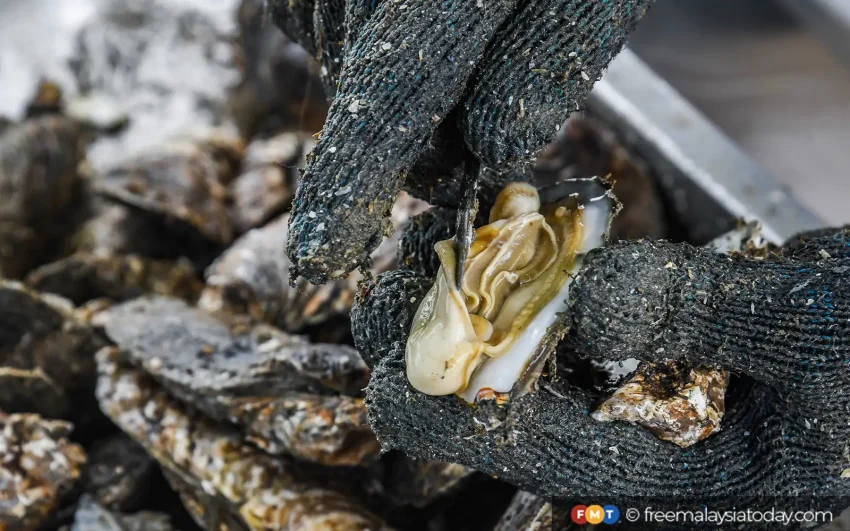
Today, it’s a different story. The once-quiet village has become a destination for seafood lovers, drawing visitors from across Malaysia and overseas in search of Muar’s famed oysters, which are prized for their quality, generous size and plump, meaty flesh.
Helping to spark that transformation is oyster supplier and wholesaler Zaidi Noh, 59, whose goal was not just to sell oysters but to put his hometown on the map.
When he started the business in 2014, Kampung Parit Tiram was barely known beyond the local community. “Back then, hardly anyone came here. Many people didn’t even know we had oysters,” he told FMT.
“So I started sharing photos and information on social media, hoping more people would discover what we have here.”
The response exceeded anything he had imagined. Strong interest eventually led Zaidi to open a restaurant, Asam Pedas PakNdak, giving visitors a place to enjoy the oysters just metres from where they are harvested, alongside other local river fish and seafood specialities.

Zaidi said he initially sold fresh oysters for about RM3 each, while a serving of 10 cooked oysters would be priced between RM35 and RM40.
Today, customers travel from every corner of the country, as well as from Singapore, Indonesia, Japan and the United States, to sample the delicacy.
“At our busiest, especially during weekends and holiday seasons, demand can reach between 3,000 and 4,000 oysters a day,” he said.
Zaidi also supplies oysters to Penang, Kuantan, Melaka, Johor Bahru and Kuala Lumpur, with orders continuing to grow. Singapore remains a market he hopes to expand into, although export permits have slowed those plans.
Notably, the oysters’ reputation is also backed by research. Studies by Universiti Tun Hussein Onn Malaysia, Universiti Sains Malaysia and Universiti Putra Malaysia have ranked Muar oysters among the finest in Southeast Asia and the Pacific Islands for their quality, size and flesh.
“The oysters here are plumper and rounder,” Zaidi explained, adding that there are two primary species in Muar’s waters: white oysters, also known as egg oysters, and a newer species called “Crassostrea (Magallana) saidii”.

Yet for all the industry’s success, Zaidi believes its future depends on attracting a new generation. He hopes more young entrepreneurs will help market Muar oysters so the industry does not rely on just a handful of people.
“If no one continues this work, there’s a real risk this product could one day disappear,” he said.
A customer from Kuala Lumpur, who wished to be known only as Seri, said the oysters lived up to their growing reputation.
“The oysters served at hotels are usually quite thin, but the ones here are wonderfully plump. They’re really satisfying to eat, and the prices are affordable too,” she said.
Diving deep for every oyster
Of course, long before Muar’s oysters reach a dining table, someone has to brave the river to harvest them.
For Zaidi’s brother, 57-year-old Zaimi Noh, it has been his life’s work. He first began diving at age 13 and has spent more than four decades harvesting wild oysters from the bed of the Muar River.

The former soldier said oyster diving demands experience, patience and nerve, especially as it is carried out without breathing equipment.
Divers only enter the water during the brief period between high and low tide, when the current is calm enough to work safely.
Using a mangrove pole driven into the riverbed as a guide, Zaimi descends into the murky water, feeling his way across the riverbed with his hands to collect oysters one by one.
This traditional method has been passed down through generations and was even recorded in the journal of a British captain as early as 1858.
“We dive to depths of between 10 and 12 feet (3.05m and 3.66m), and sometimes as deep as 33 feet (10.06m), clinging to the pole as we descend because the current is very strong.
“If we’re not careful, it could easily sweep us away,” he said.
On a good day, a diver can harvest around 5-6kg of cleaned oyster meat, which sells for between RM40 and RM50 per kilogramme.

Despite the dangers – including hearing problems and other health issues linked to years of diving – Zaimi has no plans to stop.
“Every job comes with its own risks. What’s important is having the passion and determination to provide for your family,” he said.
What concerns him more is the future of the trade. Where there were once between 40 and 70 oyster divers working these waters, only eight to 10 remain today.
“I hope more young people will step forward and carry on this tradition so our oyster-diving heritage isn’t lost to time,” he added.