
PETALING JAYA: In a world often divided by race, religion and nationality, Malaysian photographer Shukri Zali has spent more than two decades searching for what connects humanity instead.
Through his long-running documentary project, ‘La Marche de l’humanité’ (Humanity in Motion), Shukri has travelled across Southeast Asia, documenting the human condition in its many forms since 2004.
The result is a growing body of black-and-white photographs capturing minority presence, labour, faith, migration, survival and the ways people carry culture and belonging as the world around them continues to shift.
His work has earned him awards from several prestigious international competitions, including the Prix de la Photographie Paris (PX3) and the International Photography Awards (IPA).
“Since I was young, I questioned almost everything,” he told FMT Lifestyle. “Every time we think we know the truth, there is always another layer to the story.”
Shukri recalled that his trip to Sabah in 2004 started it all.
“I only went there to climb Mount Kinabalu. But when I started reading about its significance to the native communities, and learning more about their history, my passion just developed from there,” he shared.
From then on, photography became less about picturesque scenery and more about lived realities and the communities often left on the margins of mainstream attention.

Shukri said that it was during his early days as a guitar instructor that he met local artist Long Thien Shih, who introduced him to the basics of film photography.
Unlike conventional photojournalism, Shukri rarely works in haste.
“The actual act of shooting is only a small part of my process,” he said. “I will often walk around without photographing anything as I want to feel the environment first – observe, listen, meet people, and learn from life itself.”
One of his earliest accolades came in 2009 when a portrait taken in Vietnam, titled “Worried For The Young One’s Future”, won third place in the PX3 People’s Choice Awards.
The image depicts a Hmong woman and a young boy in Vietnam’s northern highlands. The Hmong are an ethnic minority community whose history has been shaped by migration, political pressure and conflict.

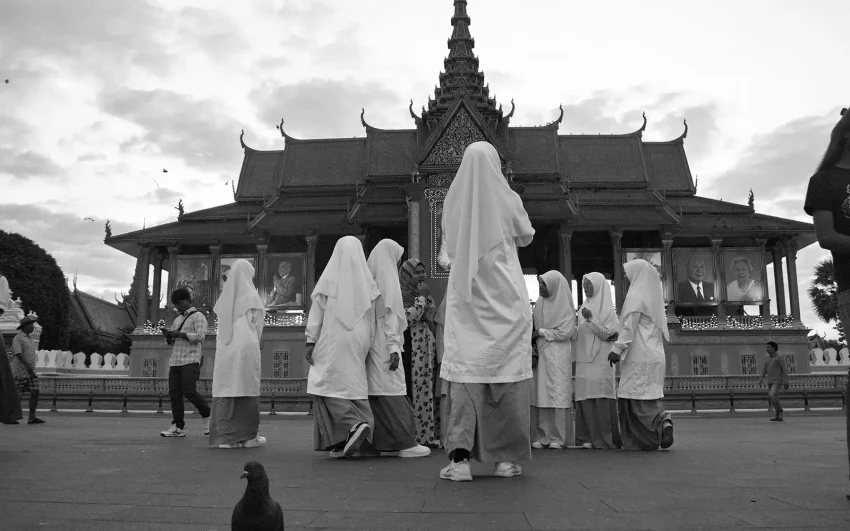
More recently, his series “Tonlé Sap” captured in Cambodia, received a Bronze Medal in the Press/General News Amateur Photoreportage category at PX3 2025.
One photograph in the series shows a group of Muslim girls in hijabs gathered near the Moonlight Pavilion at Phnom Penh’s Royal Palace.
It captures a quiet moment of Cambodia’s Muslim minority sharing the same public and cultural space as one of the country’s iconic Khmer landmarks in a predominantly Buddhist nation.
“That day, I was walking elsewhere when I had the instinct to suddenly turn around and look at the palace. I saw the Muslim girls walking towards it and I instantly knew that was the moment to capture.”
The image suggests a fragile yet powerful possibility – that different faiths, cultures, histories, and futures can coexist, not only in Cambodia but beyond its borders.
Across his body of work, Shukri moves between simple everyday moments and more difficult realities like poverty, displacement and exclusion.
His photographs include a refugee begging in France, an elderly man rummaging through rubbish in Cebu, children bathing in polluted waters, and the Bajau Laut – stateless sea nomads living along Sabah’s coast.
His decision to work predominantly in black and white is deliberate, stripping away skin colour to emphasise humankind’s similarity.

During his travels, he also encountered traditions that felt unexpectedly familiar. In Cebu, for example, he captured locals making “puso”, a woven rice dish similar to Malaysia’s ketupat.
For him, these moments reinforce the central idea behind “Humanity in Motion” – that beneath different places and cultures, the human condition remains shared.
“In the beginning of this journey, I saw the struggles of stateless communities in Sabah.” He added that years later, when travelling in Europe, he witnessed similar conditions among migrant and refugee communities there.
“So it doesn’t matter what our race, religion or background is. The struggles of the human species are more or less the same.”
While pursuing advanced studies in Europe, he continues his photography work, hoping to develop “Humanity in Motion” into a video documentary and book.
Follow Shukri Zali on Instagram.