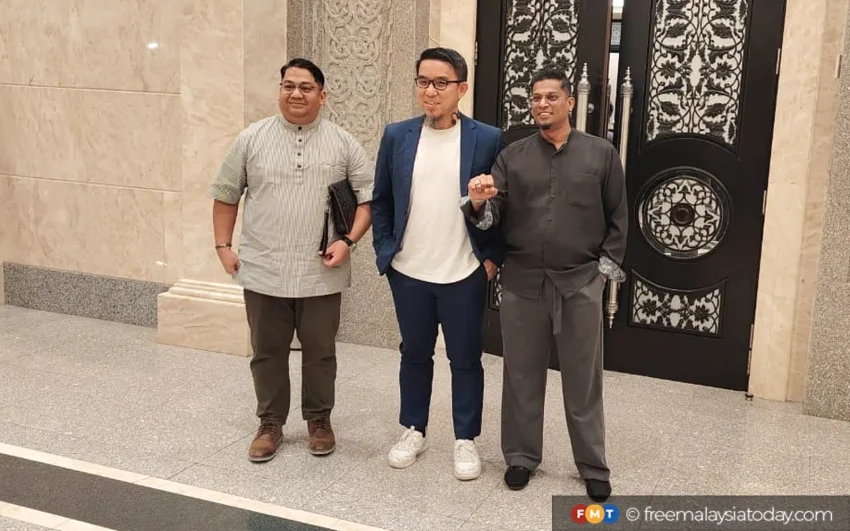

PUTRAJAYA: The Court of Appeal today reserved judgment in preacher Firdaus Wong’s appeal against a landmark High Court ruling that private individuals can be sued for allegedly infringing another person’s constitutional rights.
A three-member bench chaired by Justice Zaini Mazlan and also comprising Justices Nadzarin Wok Nordin and Latifah Tahar said the court needed more time to consider the constitutional issues raised before delivering a judgment with full grounds.
“This is an important constitutional issue. We need time to deliberate,” Zaini said, adding that the dispute was likely to reach the Federal Court regardless of the outcome.
The appeal stems from a High Court decision that found Firdaus had infringed the constitutional rights of eight non-Muslim parents through a social media video discussing how teachers should respond to minors who wished to embrace Islam and how such minors should perform prayers.
The High Court held that the video encouraged the covert conversion of non-Muslim minors and ordered Firdaus to permanently remove it from his social media platforms.
It also ruled that the parents were entitled to seek relief directly against him for violating their constitutional rights.
Counsel Norazli Nordin, appearing for Firdaus, argued that the case raised a fundamental constitutional question: whether one private citizen can sue another solely for an alleged breach of the Federal Constitution.
He submitted that constitutional rights are intended to regulate the relationship between citizens and the state, and do not, by themselves, create a private right of action between individuals.
“Since Firdaus was sued in his personal capacity rather than as a public authority, the claim was legally unsustainable,” said Norazli, who was assisted by Syahidah Hanum Ghazali and Nurul Nisa Khalid.
Norazli also said Malaysian law contains no provisions allowing one citizen to sue another solely for infringing constitutional rights.
On the facts, Norazli said Firdaus had never advised that non-Muslim minors should secretly convert to Islam or conceal such conversions from their parents.
He argued that the preacher was merely answering a question on Islamic teachings while acknowledging that the legal requirements governing the conversion of minors must still be observed.
He further submitted the parents failed to show that any child had actually been converted, that any constitutional rights had been violated, or that the video had caused any real or imminent harm.
Urging the appellate court to allow the appeal, Norazli said disagreement with Firdaus’s views or moral objections to them did not, by themselves, create a legal cause of action.
Lawyer M Visvanathan, who appeared for the parents, submitted today that the case was not about religion or Firdaus’s status as an Islamic preacher, but about protecting parents’ constitutional right to determine the religion of their minor children.
He rejected the contention that constitutional rights are enforceable only against the state, saying such rights would be rendered meaningless if courts could not intervene when they were threatened by another private individual.
“The High Court was therefore correct in declaring the video unlawful and ordering its removal,” said Visvanathan, who was assisted by Sanjay Nathan and Pushan Qin Nathan.
Visvanathan also argued that parents should not have to wait until a secret conversion actually occurs before seeking protection from the courts.
He argued that the video, viewed in its entirety, encouraged non-Muslim minors to conceal their religious practices from their parents and avoid any official record of conversion, thereby creating a real risk of harm to the parents’ constitutional rights.
He urged the Court of Appeal to uphold the High Court’s judgment, saying constitutional rights must remain capable of effective enforcement.