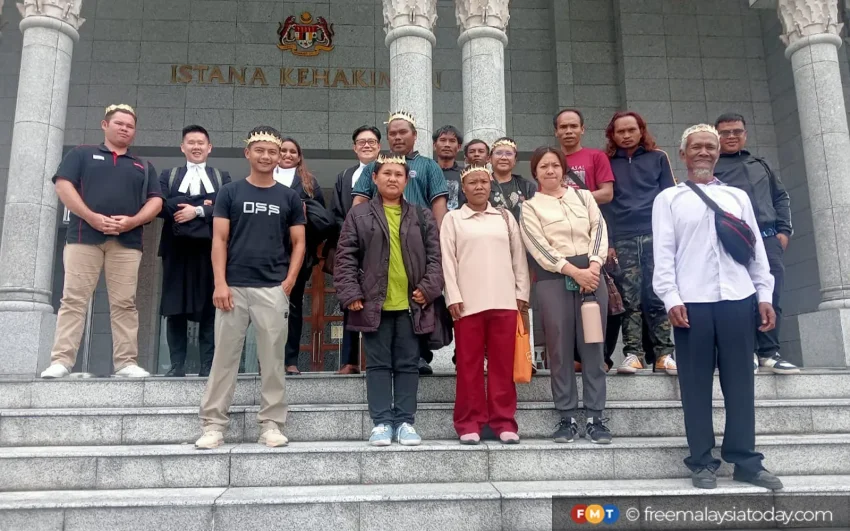

PUTRAJAYA: The Court of Appeal has set aside a High Court summary judgment awarding vacant possession of disputed land in Rompin, Pahang, to Agri Tech Sdn Bhd, ruling that the Orang Asli defendants’ claim of customary land rights raises genuine triable issues that must be determined at trial.
A three-member bench comprising Justices Azizul Azmi Adnan, Ong Chee Kwan and Latifah Tahar unanimously allowed an appeal by Koperasi Orang Asli Kampung Tanam Rompin, its chairman Ibrahim Jinal and Tok Batin Ahing Pak Kahling.
The court ordered the case remitted to the High Court for trial and awarded the appellants RM30,000 in costs.
The appeal arose from the High Court’s decision to grant a summary judgment in favour of Agri Tech, which relied on its status as the registered proprietor of the land and the principle of indefeasibility of title under Section 340(1) of the National Land Code.
The High Court ruled that the defendants failed to raise bona fide triable issues and did not provide sufficient evidence to support their claim of customary rights.
In overturning that decision, Azizul, who chaired the bench, said the case could not be decided solely on affidavit evidence due to material conflicts in the parties’ affidavits.
The court noted that the appellants had separately filed a substantive suit in the High Court against Agri Tech, the director-general of the Orang Asli development department (Jakoa), the director of the Pahang land and mines office, and the Pahang government over the same land.
Azizul said although Agri Tech’s title was issued in 2010, the central issue was whether the appellants had established customary rights over the land through continuous occupation before the title was issued.
“And if so, whether those rights could prevail over the registered title,” he said, adding that these questions involved disputed facts requiring oral evidence and cross-examination, making them unsuitable for determination through summary judgment.
The High Court last year found that the defendants failed to substantiate their claim of ancestral occupation, citing a lack of documentary evidence, photographs of alleged ancestral graves and sacred sites, and a police report suggesting that the land was only opened for cultivation in 2013.
It held that the land had never been gazetted as an aboriginal area or aboriginal reserve under the Aboriginal Peoples Act 1954, and that the defendants had not pleaded fraud, forgery or illegality to challenge Agri Tech’s registered title.
However, the Court of Appeal concluded that the competing claims over the existence and extent of the Orang Asli community’s customary rights could only be properly resolved after a full examination of the evidence at trial.
Lawyers Lai Chee Hoe, Deyvinah Ganesalingam and Jonathan Tan appeared for the appellants, while Zaharman Zainal Abidin and Ahmad Syamsul Akmar Yusof represented Agri Tech.