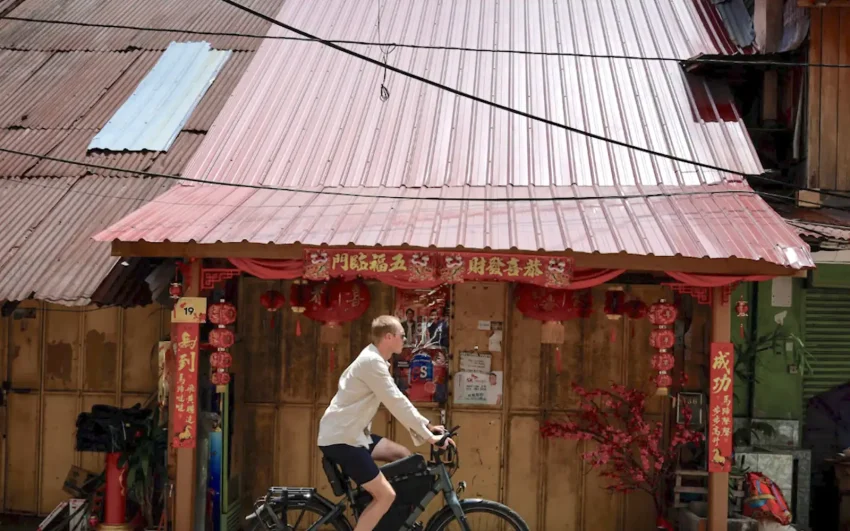

KUALA TERENGGANU: Every morning, 86-year-old Ma Suat Ngo opens the doors of her grocery shop in Kampung Cina, continuing a routine she has followed for decades.
Yet she knows businesses like hers are becoming increasingly rare.
“If no one takes over this business in the future, perhaps one day old grocery shops like this will exist only as memories in Kampung Cina,” she told Bernama.
Her concern reflects a wider reality in the historic enclave, where many younger residents have left in search of opportunities elsewhere, leaving an ageing community to preserve its traditions and way of life.
Despite these challenges, Kampung Cina remains one of Kuala Terengganu’s most distinctive heritage destinations, with a history stretching back more than 300 years.

Kampung Cina community representative and researcher Lorenz Law, 65, said the settlement is believed to have been established by migrants from China’s Hokkien region who arrived in the 17th century in search of a new life.
“By the 18th century, Kampung Cina had grown into an important trading centre due to the presence of merchants from various countries, including India, China, Vietnam and Thailand,” he said.
Today, visitors are drawn to its rows of houses and two-storey shophouses featuring Chinese vernacular architecture dating back to the 19th century, many of which still retain their original features.

Law said Kampung Cina also reflects the unique identity of the Peranakan Chinese community, which continues to speak the Terengganu dialect and practise local customs in daily life.
The area’s population is estimated at about 1,500, although the number of elderly residents continues to decline.
“Around Jalan Kampung Cina alone, there may be about 20 residents aged over 70, and around 50 if nearby areas are included. If this trend continues, the area may become even quieter within the next decade,” he said.
Conservation efforts have been ongoing since 2004, including restoration works and infrastructure upgrades such as the construction of a 1km pedestrian walkway.

According to Law, Kampung Cina’s architecture also reflects influences from Vietnam, Thailand, India and Europe, adding to its unique heritage appeal.
Beyond its historic buildings, the enclave is also known for its Peranakan culture, particularly its cuisine and lifestyle shaped by centuries of interaction with the Malay community.
“Most of the Chinese community here enjoy local dishes such as nasi dagang, nasi lemak and nasi minyak, while some traditional practices closely resemble those of the Malays,” he said.
Among those keeping the area’s traditions alive is tailoring shop owner Gau Mekhua, 73, who continues operating her decades-old business despite growing competition from ready-made clothing retailers.
“Orders are not as many as before, but long-time customers still come because they trust the quality of my work,” she said.

Hardware and household goods trader Phua Siong Khoon, 68, faces similar challenges.
“It is certainly difficult to compete with larger stores that offer a wider selection and lower prices, but I continue because I am used to this work and still have loyal customers who support me,” he said.
For Law, preserving Kampung Cina is about more than restoring old buildings. The enclave’s greatest heritage may well be the people who continue to live and work here, carrying forward traditions that have shaped the community for generations.
And as long as shopkeepers like Ma, Gau and Phua remain, Kampung Cina is more than a historical landmark: it remains a living neighbourhood where the past continues to be part of everyday life.